NOKIA (NOK)·Q4 2025 Earnings Summary
Nokia Beats on EPS as Optical Networks Surge 17%, But Stock Falls on Q1 Warning
January 29, 2026 · by Fintool AI Agent
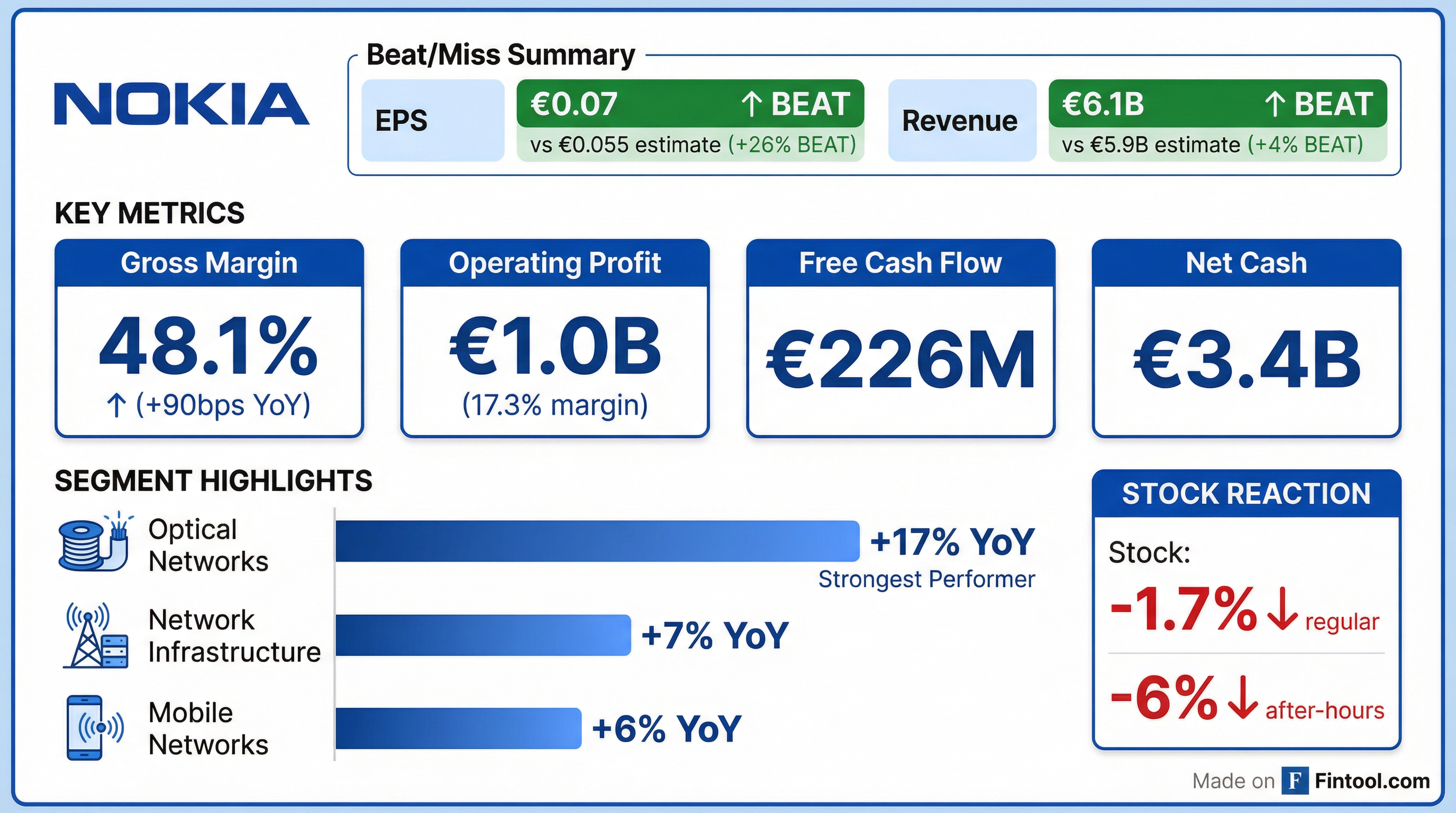
Nokia delivered a solid Q4 2025, beating EPS estimates by 26% and revenue by 4%, powered by a 17% surge in Optical Networks revenue from AI and cloud customers. Full-year operating profit of €2.0B came in slightly above the midpoint of guidance. However, the stock fell ~6% in after-hours trading after management warned Q1 2026 would be "somewhat below" normal seasonality.
Did Nokia Beat Earnings?
Yes — Nokia beat on both EPS and revenue.
Values retrieved from S&P Global
Q4 net sales grew 3% year-over-year on a constant currency basis to €6.1B, with operating profit of €1.0B. Gross margin improved 90 basis points to 48.1%, driven by improvements in Mobile Networks and Cloud and Network Services. Operating margin declined 90 basis points to 17.3%, primarily from increased investments in growth areas including the Infinera acquisition.
For the full year, Nokia delivered:
- Net Sales: €19.9B
- Operating Profit: €2.0B (slightly above midpoint of guidance)
- Free Cash Flow Conversion: 72% (within guided range of 50-80%)
- Net Cash Position: €3.4B
 Ask Fintool AI Agent
What's Driving the Optical Networks Surge?
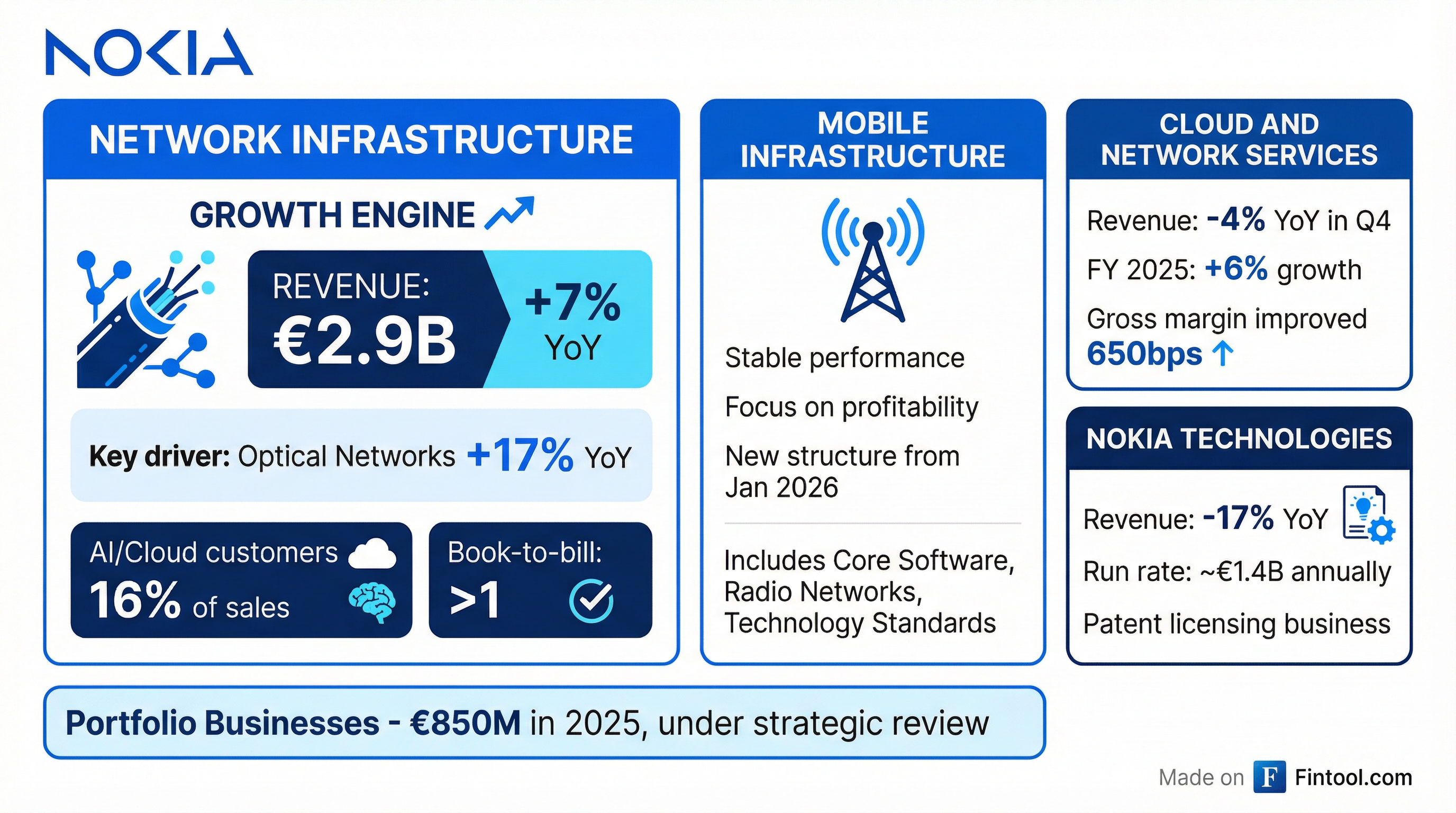
The standout performer was Optical Networks, which grew 17% YoY in Q4. AI and cloud customers accounted for 16% of total Q4 net sales and 30% of Optical Networks revenue.
Key Optical/AI Highlights:
- €2.4 billion in orders from AI and cloud customers for full year 2025
- Book-to-bill above 1 for both Optical and IP Networks, with particularly strong demand from AI and cloud customers
- 800G ZR/ZR+ pluggables shipping with multiple design wins and scaled deployments underway
- Scale-Across networking cited as a key near-term tailwind alongside speed transitions (800G → 1.6T → 3.2T)
CEO Justin Hotard emphasized the long-term opportunity: "Optical networking will become an even more critical part of the infrastructure to support the AI super cycle, and we are investing to capture near-term demand while maintaining a long-term perspective."
Nokia is increasing CapEx to €900M-€1B in 2026 (vs. typical levels) to expand manufacturing capacity for Optical Networks, particularly for their indium phosphide semiconductor fab.
What Did Management Guide?
2026 Operating Profit: €2.0B - €2.5B — implying flat to 25% growth at the high end.
Nokia outlined several KPIs from their Capital Markets Day:
Q1 2026 Warning: Management cautioned that Q1 will be "somewhat lower than normal seasonality would imply" (typically a 24% sequential decline). This reflects above-normal Q4 seasonality and telco customer purchasing patterns.
Additional 2026 Modeling Assumptions:
- Financial income/expenses: +€50M to +€150M
- Tax rate: 26-27%
- Cash taxes: ~€500M
- CapEx: €900M-€1B
- FCF conversion: 55-75%
- FX assumption: 1.18 EUR/USD
How Did the Stock React?
Despite the Q4 beat, shares fell ~6% in extended trading as investors digested the soft Q1 outlook. Nokia has gained ~70% over the past year, trading near $6.80 vs. a 52-week low of $4.00, as investors have re-rated the stock on AI infrastructure optimism.
What Changed From Last Quarter?
New Operating Structure (Effective January 1, 2026):
Nokia reorganized into a simpler structure:
- Network Infrastructure — Primary growth engine (Optical, IP, Fixed Networks)
- Mobile Infrastructure — New segment combining Core Software, Radio Networks, and Technology Standards (formerly separate units)
- Portfolio Businesses — €850M revenue, €97M operating loss in 2025. Includes FWA, CPE, microwave radio, and enterprise campus edge. Management will "conclude a future direction for each" in 2026.
- Nokia Defense — New incubation unit for defense-grade mobile and network infrastructure solutions for NATO countries
Nokia Shanghai Bell Acquisition: Nokia took full ownership of its China JV for €500M, expecting €200M in run-rate cost synergies with €350-400M integration costs over 24-36 months.
NVIDIA Partnership: Co-developing AI RAN solutions, with trials and proofs of concept expected to begin later this year.
Ask Fintool AI AgentKey Management Quotes
On the AI Opportunity:
"This market has great long-term potential... We don't see the same dynamics of the telco and internet bubble from the late nineties because this infrastructure build has been consistently constrained — power constraints, connectivity constraints, computational silicon constraints." — Justin Hotard, CEO
On European Cybersecurity Act:
"This is an opportunity for Europe to reshape its long-term competitiveness — in technology, infrastructure, innovation, and ultimately national security, sovereignty, and economic competitiveness." — Justin Hotard, CEO
On Guidance Philosophy:
"What we wanna be is disciplined around our guidance and execution and much more predictable... We're in two very different business cycles — tremendous growth in AI and cloud, flat market in telco, emerging opportunity in defense and mission-critical enterprise." — Justin Hotard, CEO
Q&A Highlights
On Optical Growth Sustainability: Management guided 10-12% combined growth for Optical and IP Networks, despite Optical growing 17% in Q4. CEO Hotard noted they're "being balanced" given they're still transitioning from a 70/30 telco-centric customer base.
On Supply Constraints: Nokia acknowledged supply constraints in the optical ecosystem, describing them as "normal with this kind of scale and build." Their indium phosphide manufacturing investments are partly aimed at supporting the broader ecosystem.
On AT&T Relationship: Despite the prior radio network contract loss, CEO Hotard emphasized AT&T remains "a very, very large strategic and important customer" across core networks and fiber access.
On Memory Cost Inflation: Management indicated memory is "not a material part" of their bill of materials and expects cost increases to be "passed through to pricing" given the market-wide impact.
Risks and Concerns
-
Q1 Seasonality: Expect below-normal Q1 decline; telco customers typically slow purchases after heavy Q4 buying
-
Margin Pressure in H1: New product introductions will impact gross margins in the first half of 2026
-
North America Radio Headwinds: Continued impact from AT&T contract loss will pressure Mobile Networks in 2026
-
Restructuring Costs: €450M cash outflow expected in 2026 for ongoing cost programs
-
Portfolio Businesses Drag: €97M operating loss from businesses under strategic review
Forward Catalysts
Ask Fintool AI AgentFor the full earnings call transcript, see Nokia Q4 2025 Earnings Call.
View Nokia company profile for more financial data and filings.